How a country defined by water became blind to the sea of garbage it lives in
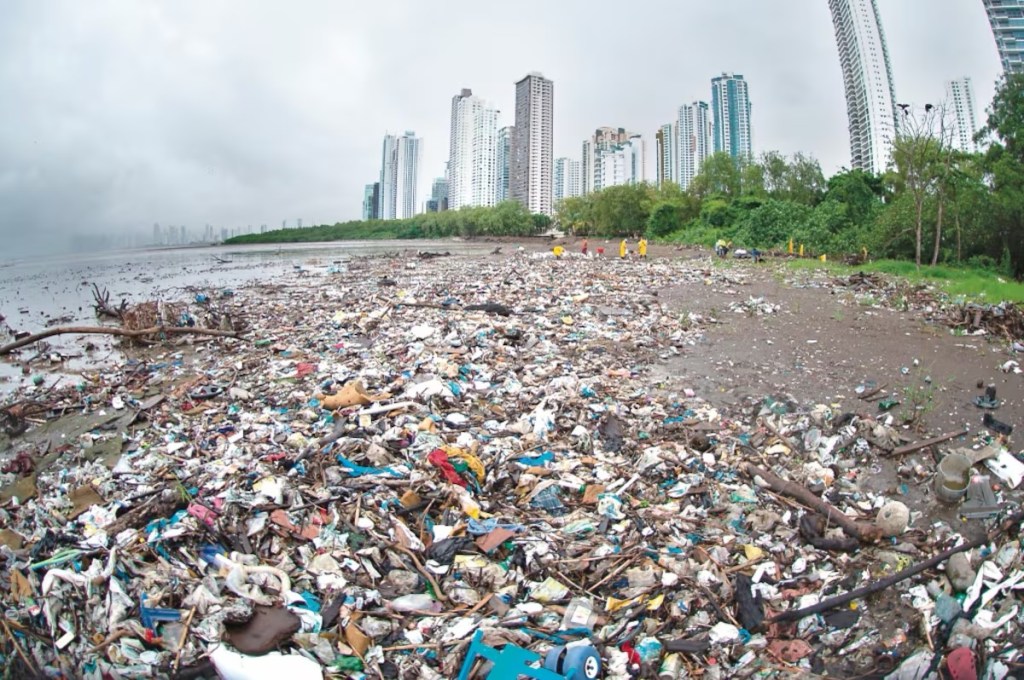
The Billion Dollar View of a Garbage Dump
Welcome to Panama, the country that owes its very existence to the oceans and treats them like a landfill. A place where billion dollar megaprojects tower over shorelines littered with plastic bags, beer cans, and crumbling refrigerators that bob in the waves.
“From the luxury penthouses of Costa del Este, Punta Pacífica, or Punta Paitilla, the privileged few enjoy panoramic views of a coastline so polluted it would make a landfill jealous.”
This isn’t just ironic. It’s national self-sabotage.
How can a country so economically and symbolically tied to the ocean allow its marine ecosystems to rot in plain sight?
Panama Is Water, or At Least It Should Be
Panama is water. Not metaphorically. Literally.
Two oceans. Hundreds of rivers. Thousands of islands. One of the most rain-soaked countries in the world. And of course, the Panama Canal, a human made artery through which six percent of global trade flows. It is the reason this nation even exists in its modern form.
You might think that in a country with this water-centric identity, protecting oceans, rivers, and coastlines would be sacred. That schools would teach it, cities would plan for it, and governments would legislate it. But that is not what happens here.
“We call ourselves the bridge of the world, but the only thing we are really connecting these days is apathy to consequence.”
We have normalized the absurd. We watch trash float past mangroves, see fish struggle to survive in bays that reek of sewage, and walk beaches that crunch under plastic instead of sand.
Panama sells itself to the world as a green paradise, but increasingly it feels like a green tinted mirage.
The Trash Is Winning
Take a walk along the Cinta Costera after a heavy rain. What you will see is not driftwood or seashells, but a slurry of plastic bottles, snack wrappers, sanitary pads, broken shoes, and the occasional appliance washed down from the city’s storm drains. The bay becomes a liquid landfill, and the stench can travel blocks inland.
The problem is not new, and it is not subtle.
For years, local organizations like Marea Verde have tried to stem the tide. Their famous trash barrier on the Matías Hernández River is an impressive feat of civil responsibility. They even use drones powered by artificial intelligence to monitor the flow of garbage. But here is the uncomfortable truth: it is a bandaid on a bullet wound.
Now enter The Ocean Cleanup, an international initiative with a much larger scope and a bold vision. They have identified Panama as one of the critical choke points for ocean plastic entering the Pacific and the Atlantic. Their efforts could make a dent. But they are still testing prototypes. Still building capacity. Still doing the work our government should have done decades ago.
“This is what we have come to. A country famous for connecting oceans, now depending on a Dutch nonprofit to clean up its rivers.”
Where Is the Government?
This is not just a matter of infrastructure. It is a matter of priorities.
Panama has no nationwide recycling mandate.
No coordinated system for separating waste.
No meaningful enforcement of existing environmental laws.
No public awareness campaign strong enough to shift behavior.
Even basic things like composting or limiting single use plastics are left up to isolated municipalities or private citizens. Meanwhile, national politicians rarely, if ever, mention the issue. Not during elections. Not during international climate summits. Not even when garbage visibly piles up at the steps of our most iconic neighborhoods.
The Ministry of Environment exists, yes, and it can publish reports or plant trees for Earth Day. But real action, the kind that rewrites budgets and rewires systems, is missing.
Entire cities grow without a single sorting center or trash recovery facility. Tourism ads promise crystal waters while wastewater drains into the same ocean we are trying to sell.
It is not ignorance.
It is indifference.
Why Don’t People Care?
Maybe the more honest question is, do they even know?
If you grow up in a city where rivers are brown and beaches are off limits after the rain, you might think that is just the way nature looks. If you live in a condo where trash disappears down a chute and never gets seen again, why would you wonder where it ends up?
The problem is not just negligence. It is detachment.
Many Panamanians, especially in urban areas, are physically and mentally removed from the natural world that surrounds them. The sea is something you drive past. The jungle is something you escape from. The canal is just background.
And those who do care, who try to recycle, who clean up the beach on weekends or ask for policy change, end up exhausted. Because individual effort cannot fix structural failure.
“The message is clear. You can care, but it will not matter unless everyone else does too.”
But perhaps the most perplexing part of all this is how quiet the country remains about it.
Panama is a place where people go out to the streets for almost everything, from corruption to fuel prices to mining concessions to education cuts, even potholes. Right now, as this is being written, there are active protests happening across the country.
And yet, when it comes to our trash-filled rivers, our collapsing coastlines, our dying mangroves, and our floating refrigerators, there is only silence.
Not a march. Not a sign. Not even a trending hashtag.
“We are a country of protestors, but no one ever protests this.”
We have also imported the worst habits of urban consumerism without the systems to manage its consequences. More packaging. More deliveries. More waste. But no bins. No rules. No accountability.
And when the government shrugs, people follow.
What Needs to Happen
This is not about doing better. It is about doing something. Anything.
Panama needs a real environmental policy, not just a slogan.
It needs mandatory recycling at the national level, not voluntary neighborhood projects.
It needs investment in waste processing, not just beachfront beautification.
The country needs to treat garbage like a threat to its economy, to its health, and to its international reputation. Because it is.
Tourists will not come to snorkel in a soup of plastic. Foreign companies will not praise a hub that lets trash choke its rivers. Residents will not feel pride in a country where luxury towers overlook marine landfills.
“We need leadership. Real leadership. One that understands environmental protection is not a luxury or a charity project. It is infrastructure. It is policy. It is survival.
And we need it now.”
A Country Between Oceans, Acting Like It Has None
Panama has always been defined by geography. By water. By connection.
But we are acting like a landlocked nation with no coast to protect, no sea to depend on, and no future to preserve.
If we continue like this, the only thing we will be known for is waste.
Not the miracle of the canal.
Not the biodiversity of our forests.
Not the meeting of two oceans.
Just a coastline of rot, seen from the sky lounges of million dollar penthouses.
“We had it all. We just didn’t care enough to keep it.”
What Do You Think?
Are we being too harsh? Not harsh enough?
What would it take for Panama to finally reclaim its connection to the oceans?
Leave your thoughts below. Let’s make some noise, because silence is part of the problem.

 What’s Up With That?
Leave a reply to Anonymous Cancel reply